July 7, 2026; By Benjamin Kosubevsky
Hair loss is one of the most emotionally charged aesthetic concerns that patients bring to our clinic, and for residents of Bal Harbour and Miami Beach—communities where appearance, confidence, and professional image carry significant weight—the desire for evidence-based solutions is understandably high. Platelet-rich plasma (PRP) therapy for hair restoration has moved from the margins of aesthetic medicine to a well-studied, physician-supervised option with a growing body of peer-reviewed support. Here is what you should understand before your first session.
The most common form of hair loss in both men and women is androgenetic alopecia—a genetically mediated process in which hair follicles gradually miniaturize and produce thinner, shorter hairs before eventually ceasing to produce visible hair altogether. In men, this typically manifests as temporal recession and vertex thinning. In women, it more commonly presents as diffuse thinning along the midline part. A comprehensive review published in the New England Journal of Medicine described androgenetic alopecia as affecting approximately 80% of men and 50% of women by age 70, making it one of the most prevalent dermatological conditions worldwide.
Other contributing factors may include nutritional deficiency (particularly iron, vitamin D, zinc, and biotin), thyroid dysfunction, chronic stress, autoimmune conditions (such as alopecia areata), and the cumulative effects of styling, chemical treatment, and environmental damage. At The Longevity Center FL, our practitioners evaluate these potential contributors before recommending any aesthetic intervention—because treating the hair without addressing the underlying physiology often leads to disappointing results.
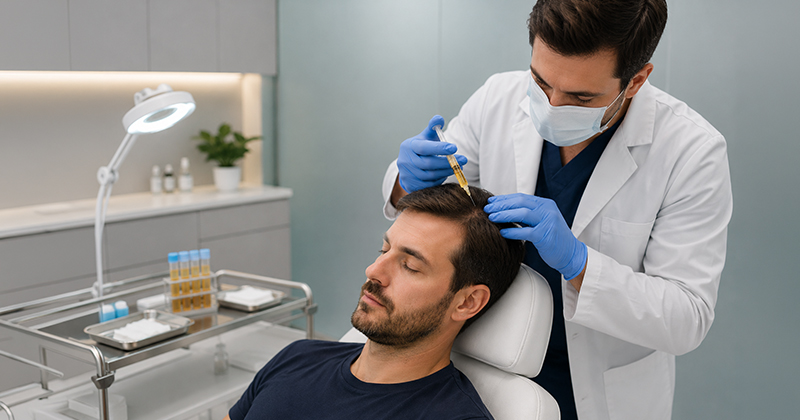
Platelet-rich plasma is prepared from the patient’s own blood. A small blood draw is processed in a centrifuge to concentrate platelets and their associated growth factors—including platelet-derived growth factor (PDGF), vascular endothelial growth factor (VEGF), transforming growth factor beta (TGF-β), and insulin-like growth factor (IGF-1)—which are then injected directly into the scalp at areas of thinning.
The rationale is rooted in the biology of the hair follicle. Published research has described how growth factors released from activated platelets may promote proliferation of dermal papilla cells, extend the anagen (growth) phase of the hair cycle, and support neovascularization around the follicle. A randomized controlled trial published in Dermatologic Surgery evaluated PRP injection in patients with androgenetic alopecia and found statistically significant increases in hair count and hair thickness compared to placebo at six months.
A systematic review and meta-analysis published in the Journal of Cosmetic Dermatology pooled data from multiple controlled trials and concluded that PRP injections were associated with a significant increase in hair density and thickness compared to control treatments, though the authors noted variability in protocols and called for further standardization (Giordano et al., J Cosmet Dermatol, 2018).
It is important to set realistic expectations. PRP for hair loss is supported by a growing evidence base, but it is not a miracle cure. Based on published research and clinical experience, here is what patients should understand:
At The Longevity Center FL, PRP hair restoration is not offered as a standalone cosmetic procedure disconnected from your broader health picture. Our practitioners begin with a comprehensive evaluation that may include laboratory testing for hormonal, nutritional, and thyroid markers—because the health of your hair is a reflection of your overall physiology.
PRP is prepared in our clinic from your own blood, ensuring that the product is autologous (self-derived) with no risk of allergic reaction or rejection. The concentrated platelet solution is injected into the scalp using a series of small injections, with optional topical numbing for comfort. Most sessions take approximately 45 to 60 minutes, and there is no significant downtime.
A review published in the International Journal of Molecular Sciences summarized the molecular mechanisms underlying PRP’s effects on hair follicle biology, including the stimulation of Wnt/β-catenin signaling and the promotion of dermal papilla cell survival (Gupta & Carviel, Int J Mol Sci, 2017). These mechanisms provide a biologically plausible framework for PRP’s observed clinical effects, though the authors noted that protocol optimization remains an active area of investigation.
The best candidates for PRP hair restoration at our clinic are individuals who are experiencing early to moderate hair thinning, who have realistic expectations about the timeline and degree of improvement, and who are willing to commit to a course of multiple sessions. Patients of any gender may benefit. PRP is particularly relevant for individuals who prefer a natural, autologous approach and who want to avoid or defer pharmaceutical interventions such as finasteride or minoxidil.
The Longevity Center FL is located at 580 Village Blvd, Suite 210 in West Palm Beach. Residents of Bal Harbour and Miami Beach can reach our clinic in approximately 65–75 minutes via I-95. For patients considering a treatment series, our scheduling team can help coordinate appointments to minimize trips.
If hair thinning is affecting your confidence and you want an evidence-informed, physician-supervised approach that evaluates the full picture—not just the scalp—we welcome the opportunity to discuss whether PRP hair restoration is right for you.
PRP for hair restoration is an autologous blood-derived therapy and has not been FDA-approved for the treatment of hair loss. It is offered at The Longevity Center FL under physician supervision. Published clinical evidence supports its use for androgenetic alopecia, but results vary by individual, severity of hair loss, and adherence to treatment protocols. No specific outcomes are promised or guaranteed. This post is for educational purposes only.
Give Us a Call +1 (561) 210-4033
Schedule a consultation at The Longevity Center FL in West Palm Beach. [Schedule an Appointment]
The information in this blog post is provided for educational purposes only and does not constitute medical advice, diagnosis, or treatment. Individual results vary. This content is not intended to be a substitute for professional medical advice. Always consult a qualified healthcare professional regarding any medical condition, symptom, medication, or treatment decision. Peer-reviewed research cited reflects population-level or study-level findings and does not predict individual outcomes. The Longevity Center FL does not claim to diagnose, treat, cure, or prevent any disease through the services discussed.

Dr. Benjamin Kosubevsky is a board-certified expert in regenerative and integrative medicine. He’s developed his own Ozone Dialysis (EBOO) protocols for more effective, lasting results. With training from leading organizations in ozone, stem cell, and chelation therapies, he offers advanced treatments like PRP, BMAC, and OMT. Dr. Kosubevsky blends traditional and holistic care to create personalized plans that support natural healing. He also co-hosts the Peak Performance Podcast, where he shares insights on health, recovery, and optimal living.
 The Evidence for Stellate Ganglion Block Has Caught Up With the Anecdotes
 What the Chelation Trials Actually Found, and Why Measurement Changes Everything
 Your Biological Age Test Is Less Precise Than You Think
 The Question About Regenerative Injections That Almost Nobody Asks
 What a Century of Blood Filtration Taught Me About Judging a New Therapy


