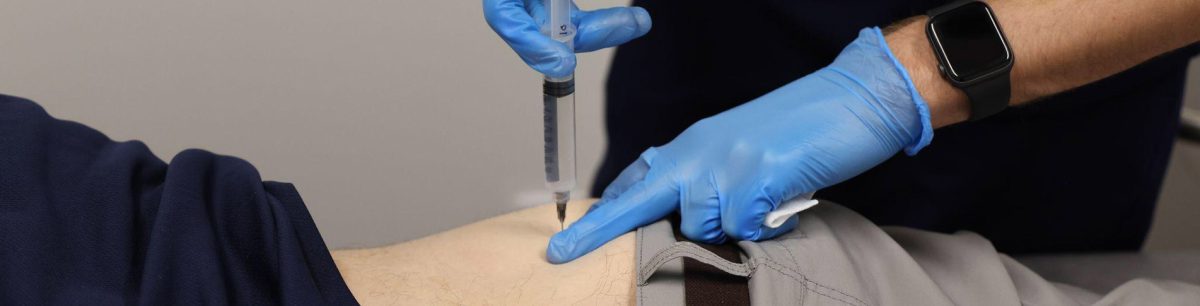
What is Prolotherapy?
Prolotherapy involves the injection of a solution, typically hypertonic dextrose, into injured or degenerated tissues. This solution acts as an irritant, promoting a localized inflammatory response that triggers the body’s healing mechanisms, resulting in the regeneration of tissues such as ligaments, tendons, and joints.
Frequently Asked Questions
What is prolotherapy?
Prolotherapy involves injecting an irritant solution, most often dextrose-based, into ligaments or tendons to stimulate a localized healing response. The mild irritation triggers controlled inflammation and growth factor release, which promotes collagen repair in lax or weakened connective tissue. It is used for chronic ligament and tendon problems, joint instability, and osteoarthritis. It is frequently chosen by patients who want an alternative to repeated steroid injections, which can weaken tissue over time.
How does prolotherapy work?
The injected solution creates a controlled inflammatory response that draws immune cells and growth factors into the treated area. Over subsequent weeks, this stimulates collagen deposition and strengthens the connective tissue, which is why it is particularly useful for chronic ligament and tendon laxity. Because the mechanism depends on inflammation, patients are generally asked to avoid NSAIDs around therapy. The effect builds progressively across a series rather than occurring after a single injection.
What conditions does prolotherapy address?
Prolotherapy is used for chronic ligament and tendon injuries, joint instability, low back pain, knee pain, osteoarthritis, sacroiliac dysfunction, and sports injuries. It is often chosen by patients seeking alternatives to steroid injections or surgery, particularly when instability rather than acute inflammation is driving the pain. Candidacy is determined through a consultation that includes physical examination and review of any relevant imaging, since prolotherapy suits some pain patterns better than others.
Is prolotherapy the same as PRP?
No. Prolotherapy uses an irritant solution such as dextrose to provoke a healing response, while PRP uses a concentration of your own platelets and their growth factors. PRP is generally more expensive and involves a blood draw; prolotherapy is simpler and lower cost. They can sometimes be combined or used in sequence. Your provider will recommend one or the other based on your condition, tissue quality, and budget.
How many prolotherapy sessions are needed?
A typical course includes 6 to 10 sessions spaced 2 to 4 weeks apart. Chronic, long-standing, or severe conditions may require additional therapies. The interval allows the healing response from each injection to progress before the next one. Your provider reassesses partway through the series to determine whether to continue, adjust the solution concentration, or change approach based on how you are responding.
Does prolotherapy hurt?
There is discomfort during injection and typically temporary soreness and swelling for 24 to 72 hours afterward as the intended inflammatory healing response begins. This post-injection soreness is expected rather than a sign of a problem. Most patients find it manageable and short-lived. Because NSAIDs may blunt the therapeutic effect, your provider will advise which pain relievers are appropriate to use during that window.
Is prolotherapy FDA approved?
The solutions used, such as dextrose, are FDA-approved for other medical purposes, but prolotherapy itself is off-label for orthopedic indications. Your provider reviews the regulatory status, available clinical evidence, potential benefits, and known risks during informed consent before therapy begins. Evidence quality is strongest for knee osteoarthritis, where several randomized trials exist, and weaker for some other applications.
How long before prolotherapy works?
Some patients feel improvement after the first session, but full benefit usually appears after completing the entire course. Healing continues for weeks to months following the final injection as collagen remodels. This gradual timeline differs from a steroid injection, which relieves pain quickly but does not strengthen tissue. Progress is reviewed at follow-up visits, and individual response varies with age, tissue quality, and the chronicity of the problem.
Can prolotherapy help knee osteoarthritis?
Yes. Dextrose prolotherapy has shown benefit for knee osteoarthritis pain and function in several randomized controlled trials, making this one of its better-supported applications. It is a reasonable option for patients who want to avoid repeated corticosteroid injections, which may accelerate cartilage loss with frequent use. It does not regrow cartilage or reverse advanced structural damage. Results vary, and patients with bone-on-bone arthritis generally see less benefit than those with earlier-stage disease.
Is prolotherapy covered by insurance?
No. The clinic does not bill insurance for any service. Prolotherapy is rarely covered elsewhere either, and Medicare specifically excludes it. Because a typical course runs three to six sessions, ask about multi-session pricing during your consultation, since meaningful discounts are available on a series even where package rates are not published. Whether an HSA or FSA card is accepted depends on your carrier.
The information in these FAQs is for educational purposes only and is not a substitute for professional medical advice, diagnosis, or therapy. Individual results vary. Some therapies discussed are considered off-label or investigational and are not FDA-approved for all conditions. Consult with a licensed provider at The Longevity Center FL to determine what is appropriate for you.