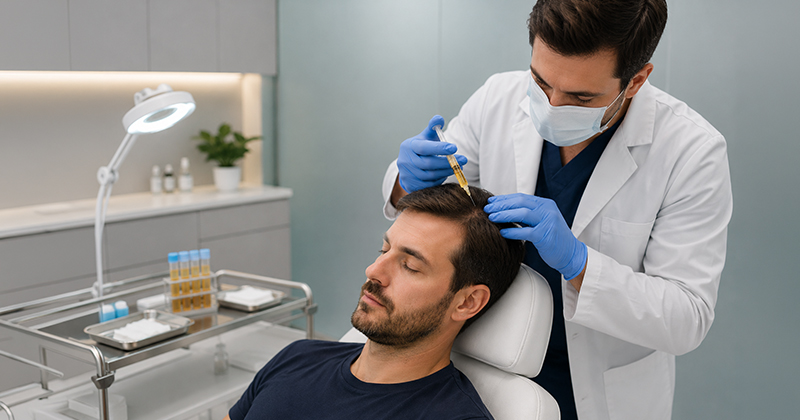
Revitalize your hair with Platelet-Rich Plasma (PRP) injections offered by Dr. Benjamin Kosubevsky. This innovative treatment leverages your body’s natural healing properties to stimulate hair growth, increase hair thickness, and improve overall scalp health.
What are PRP Injections for Hair Restoration?
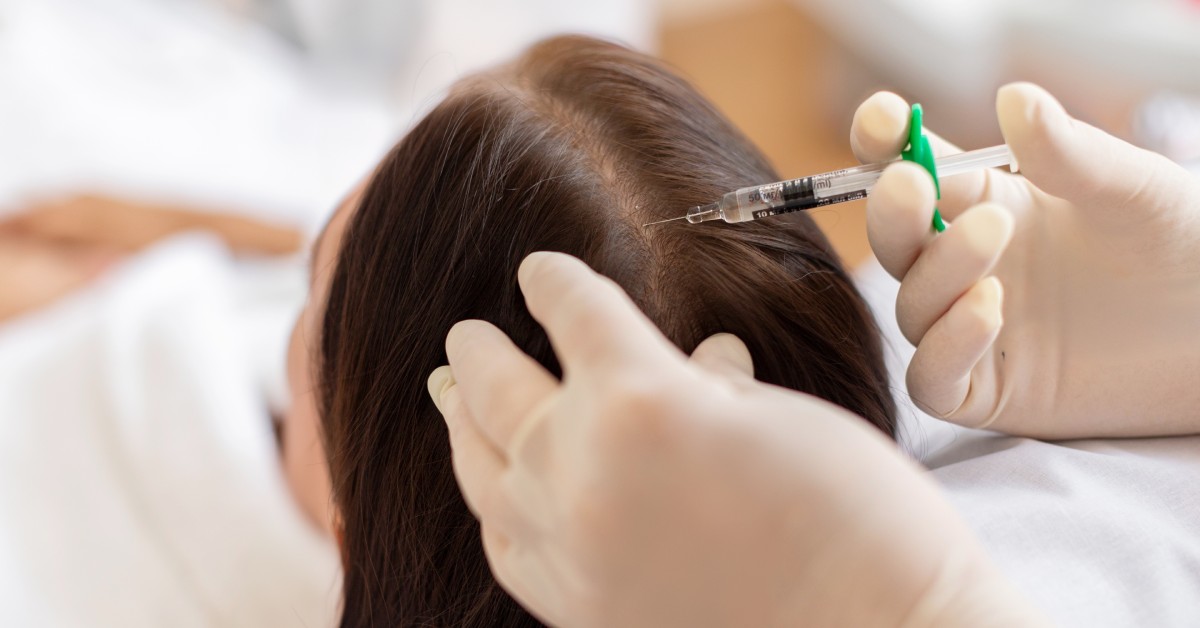
PRP injections for hair restoration involve drawing a small amount of your blood, processing it to concentrate the platelets, and injecting the PRP into areas of the scalp affected by hair loss. The platelets release growth factors that promote hair follicle regeneration, prolong the anagen (growth) phase of hair cycles, and reverse the miniaturization of hair follicles.
Benefits of PRP Injections for Hair Restoration
Dr. Kosubevsky offers customized PRP injection treatments to address various hair loss concerns, providing benefits such as:
Improved Hair Density and Thickness
PRP therapy has been shown to significantly improve hair density and thickness in patients with androgenetic alopecia. Studies have demonstrated a 29.2% increase in hair count and a 46.4% increase in hair thickness after three PRP sessions (American Hair Loss Association) (Defy Medical).
Enhanced Hair Follicle Regeneration
PRP stimulates the regeneration of hair follicles, promoting the growth of new, healthy hair (Dove Med Press).
Increased Hair Shaft Diameter
Research indicates that PRP can increase hair shaft diameter, making hair appear fuller and thicker (Wimpole Clinic) (Defy Medical).
PRP uses your body's own blood, minimizing the risk of allergic reactions or adverse effects. The treatment is minimally invasive with little to no downtime (American Hair Loss Association) (Defy Medical).
Long-Lasting Results
The benefits of PRP therapy can last for several months, and maintenance sessions can help sustain the results over time (American Hair Loss Association) (Defy Medical).
Dr. Benjamin Kosubevsky combines extensive medical expertise with a patient-centered approach to deliver exceptional care. He provides:
Board Certification and Expertise: Kosubevsky is board-certified by the American Academy of Stem Cell Physicians (AASCP) and experienced in the latest regenerative medicine techniques.
Personalized Treatment Plans: Customized PRP therapy protocols tailored to your specific hair restoration needs.
Holistic Approach: Integrative methods combining traditional and alternative medicine practices for comprehensive care.
Scientific Expertise: Utilizing evidence-based methods to ensure safe and effective treatments.
Unlock Your Hair Restoration Potential
PRP injections for hair restoration offer numerous benefits, including improved hair density, increased thickness, and enhanced overall scalp health. Whether addressing specific hair loss concerns or aiming to optimize your overall hair wellness, Dr. Kosubevsky’s PRP therapy can help you achieve your goals.
PRP can stimulate dormant hair follicles, improve follicle health, and slow hair loss in many patients. It works best when follicles are still present but miniaturized, which is characteristic of early-to-moderate pattern hair loss. It is not effective in completely bald areas where follicles are no longer active, since PRP supports existing follicles rather than creating new ones. Results vary considerably depending on the cause and stage of hair loss.
Androgenetic alopecia, commonly called pattern hair loss, responds best, as does thinning related to stress, postpartum hormonal shifts, or nutritional deficiency. PRP is considerably less effective for scarring alopecias such as lichen planopilaris or frontal fibrosing alopecia, where the follicle is permanently destroyed. Identifying the type of hair loss matters, so evaluation and sometimes lab work or scalp examination precede therapy.
Blood is drawn from your arm and processed in a centrifuge to concentrate the platelets. The resulting PRP is injected into the scalp in a grid pattern across the thinning areas, or applied following microneedling. Topical numbing or a ring block improves comfort. The injection portion typically takes 15 to 20 minutes. You will receive aftercare instructions, including when you can wash your hair and resume exercise.
There is mild to moderate discomfort from scalp injections, which many patients describe as brief stinging or pressure. Numbing cream applied beforehand helps considerably. Most people tolerate the procedure well. Scalp tenderness, tightness, or mild swelling may last 24 to 48 hours afterward and typically responds to acetaminophen, since NSAIDs are usually avoided following PRP.
Most protocols begin with 3 to 4 monthly sessions, followed by maintenance every 3 to 6 months. Consistency matters, since discontinuing maintenance generally allows gradual return to the prior rate of loss. PRP does not permanently halt androgenetic alopecia, which is a progressive condition. Your provider will recommend a schedule and may suggest combining PRP with other modalities.
Early thickening of existing hair may appear at 2 to 3 months, with best results typically seen between 6 and 12 months. Hair growth follows slow biological cycles, so patience is necessary, and photographs taken at baseline help track change objectively. Some patients notice reduced shedding before they see visible thickening. Individual results vary, and some patients see minimal change despite completing a full series.
It is generally safe because it uses your own blood, making allergic reactions very unlikely. Temporary scalp tenderness, redness, mild swelling, or small bruises may occur and resolve within a day or two. Infection is rare with sterile technique. Patients with bleeding disorders, those on anticoagulants, or those with active scalp infection require evaluation before therapy. Your provider screens for these during consultation.
No. PRP is not effective where follicles are no longer active, since it works by supporting and revitalizing existing follicles rather than generating new ones. Hair transplantation is generally the appropriate option for completely bald areas, and PRP is sometimes used alongside transplantation to support graft survival. Your provider will assess follicle status during consultation and give you an honest opinion about whether PRP is worth pursuing.
Yes. PRP is commonly used for female pattern hair loss and for postpartum or stress-related thinning, both of which often respond well. Because hair loss in women frequently has an underlying medical driver, evaluation typically includes checking iron and ferritin, thyroid function, vitamin D, and hormonal status. Correcting an identified deficiency often matters as much as the PRP itself. A consultation determines whether you are a good candidate.
Aesthetic therapies at the clinic start at $450, with hair restoration pricing depending on the number of sessions and whether you purchase a series. Because PRP hair restoration requires an initial series of three to four sessions plus maintenance every three to six months, the long-term cost is worth discussing upfront rather than session by session. This is a self-pay service. Call (561) 210-4033 for current rates and series pricing.
PRP Hair Restoration: What South Florida Men and Women
Hair loss is one of the most emotionally charged aesthetic concerns that patients bring to our clinic, and for residents of Bal Harbour and Miami Beac...
Hair loss affects millions of people, yet finding a solution that feels natural and effective is difficult. Many individuals notice thinning strands o...
6 Things To Know About Platelet Rich Plasma (PRP) Treat
Platelet Rich Plasma (PRP) treatments use something completely natural to address a range of concerns, from skin and hair to wellness. But how does it...